The periods of infancy, toddlerhood and early school-age are remarkable for the amount of cognitive development that takes place and even more remarkable that it comes out the way it does and works it’s way into the right form for the culture.
Children's thought processes are not like those of an adult. Thinking is related to how people see things, hear things and then sift and shift those "things" around in their head - and children do these differently than do adults.
Often adults want to say the child is "wrong" when they say, see or do something different from what adults would do. But they are not wrong - they are children! Think back to when we talked of biases.
In most families there are those hilarious anecdotes centered around the child doing what children do – interpreting the world their “correct” way. I remember a friend of mine whose four-year-old daughter said she wanted to play the piano. She asked her mother to get her a certain book of music and open it to a page where a favorite song appeared. The child sat down at the piano, hovered her fingers over the keys and waited. A short time later the child said “nothing’s happening.” After a mother- child conversation about this it turned out the child had the concept piano, book, hovering fingers make music. After all she had seen her mother sit down open the book hover her fingers over the keys and suddenly there was music.
What she did not know was that there were other steps to the concept - one of which was that the fingers had to MOVE onto the notes. She had not SEEN that part of the concept and what she did not see could not be used in her thought process. You might say but she had to have seen the fingers move - well - yes - her eyesight was perfect- but seeing and “seeing” are different phenomenon.
One time I was testing a 5-year-old and the IQ test required the child to copy a diamond shape. The child drew a perfect circle. I asked my usual “are you sure you are done?” and he said yes he was done and added “I drew the diamond ring for you.”
According to the test he failed that item - he might not have really listened to the instructions or he might have and did his own thing anyway. Children are like that.... It’s also why I don’t like IQ tests for giving a score - they are often more useful as measures of what the child’s thought processes are.. Incorrect answers [those that don’t agree with the test manual] are often of greater value to the tester than an IQ score. That’s my personal bias when I am the tester but that’s a topic for another time.
I mentioned that the above example may have related to what the child heard. Like seeing is not always “seeing,” hearing is not always “hearing.” Most of us know about the “icing” song - [“My country ‘tis of thee, sweet land of liberty, of the icing.”] We hear of Round John Virgin [“round yon virgin” and laugh. The child saying these things is not trying to be funny. It’s what he/she is hearing. When you hear words you try to fit them into already existing concepts - that’s the sifting and shifting part of learning. If you don’t now have a particular concept - you shift and sift into one’s you do have.
As you get older, and develop many different kinds of concepts, you tend to put the words into a more correct “location.”
All this leads to interesting ideas that get studied - especially in different cultures. If you don’t have a word for a concept, can you actually have that as a concept? If you don’t actually see [perceive] something, can you have a word for it? And can you have a concept for it? Language, concepts and perception are tied together in our brains.
We are mostly products of American culture and TV and we have a set of concepts, perceptions and language more or less typical for our culture. But that can be very different from what is thought, perceived and spoken of elsewhere - even if you and the person from a different culture seem to be looking at, talking about and thinking about the same thing.
Can you even imagine how a young child tries to figure it all out?
And does!
Monday, April 10, 2006


Wednesday, March 01, 2006
What kids "see"
Different points of view!

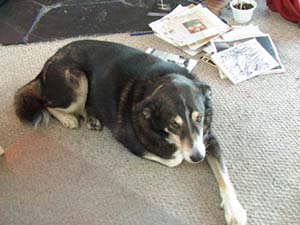
Here's my dog from my the view point of a baby who crawls on the floor and then from the adult point of view.


Here is a hanging plant from the view of a toddler who can walk under it.
And here is what an adult sees.


The TV set from the floor or low child type seat.
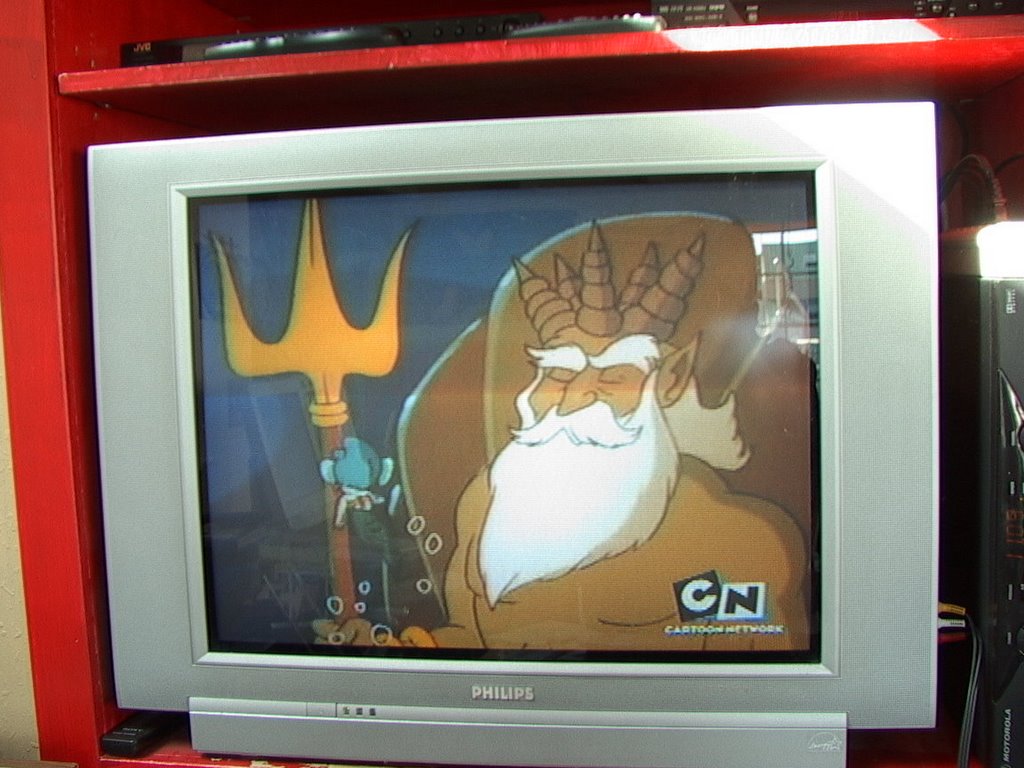
And from an adult view.

Take a crawl along your floors - see what your child sees. If you have a toddler- take a walk on your knees!

Here's my dog from my the view point of a baby who crawls on the floor and then from the adult point of view.
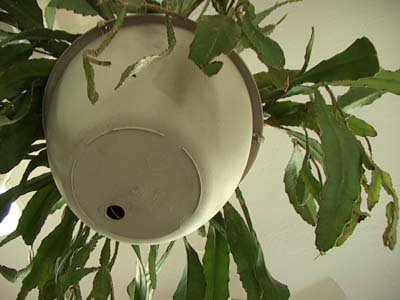
Here is a hanging plant from the view of a toddler who can walk under it.
And here is what an adult sees.

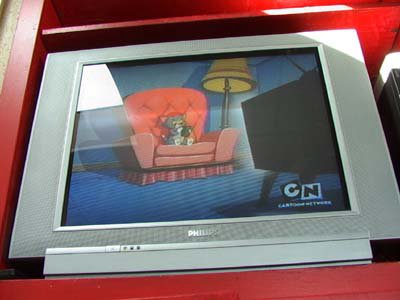
The TV set from the floor or low child type seat.
And from an adult view.
Take a crawl along your floors - see what your child sees. If you have a toddler- take a walk on your knees!
Friday, February 03, 2006
Seeing IS believing!
Baby does see! Even that newborn sees. We are born able to see yet I still hear well educated adults saying that their newborn "looks as if she is looking at me but I know she can't see me."
Well the adult is incorrect. The newborn sees but has more accurate vision in a range of about 10 inches. That's just about the distance baby is from the adult face when the baby is being held or being breast fed.
As the baby ages, the vision improves and we see babies actively watching and following objects with the eyes. Remember what was said in the last posing about our "old" perceptions of children. Go look at the picture of the newborn. See how large the head is? The head of a newborn is almost it's adult size - it's BIG. The head is well developed at birth and the eyes work - but the head is still too large for the baby to control - so the eyes follow but it will take more growth for the head to follow. [That's also why we carefully hold a baby's head when we pick it up and cradle it.]
As the baby develops, perception is an important part of the cognitive process. For a young infant, if an object can not be seen - it does not exist! So seeing IS believing.
An interesting task for adults is to get ourselves down on the level of an infant and start looking around. What do you REALLY see? More about this next time - with photos.
Well the adult is incorrect. The newborn sees but has more accurate vision in a range of about 10 inches. That's just about the distance baby is from the adult face when the baby is being held or being breast fed.
As the baby ages, the vision improves and we see babies actively watching and following objects with the eyes. Remember what was said in the last posing about our "old" perceptions of children. Go look at the picture of the newborn. See how large the head is? The head of a newborn is almost it's adult size - it's BIG. The head is well developed at birth and the eyes work - but the head is still too large for the baby to control - so the eyes follow but it will take more growth for the head to follow. [That's also why we carefully hold a baby's head when we pick it up and cradle it.]
As the baby develops, perception is an important part of the cognitive process. For a young infant, if an object can not be seen - it does not exist! So seeing IS believing.
An interesting task for adults is to get ourselves down on the level of an infant and start looking around. What do you REALLY see? More about this next time - with photos.
Subscribe to:
Posts (Atom)